Clinical Reasoning in Medicine: Diagnostic Thinking & Cognitive Biases
Master clinical reasoning frameworks, Dual-Process Theory (System 1 vs System 2), Illness Scripts, Diagnostic Error Prevention, and Cognitive Biases.
Table of Contents (10 Sections)
Clinical Reasoning in Medicine: Diagnostic Thinking & Cognitive Biases
---
📌 Interactive Table of Contents (Index)
- 1. Introduction & Dual-Process Theory
- 2. System 1 vs System 2 Cognitive Thinking
- 3. Illness Scripts & Pattern Recognition
- 4. Top 10 Cognitive Biases in Diagnostic Errors Table
- 5. Diagnostic Debiasing & Metacognitive Checklist
- 6. Advanced Probabilistic Reasoning Equations
- 7. Flagship Worked Clinical Case Study
- 8. High-Yield Clinical Pearls for Attending Rounds
---
1. Introduction & Dual-Process Theory
Clinical reasoning is the cognitive process by which clinicians synthesize diagnostic data, formulate differential diagnoses, and make therapeutic decisions.
---
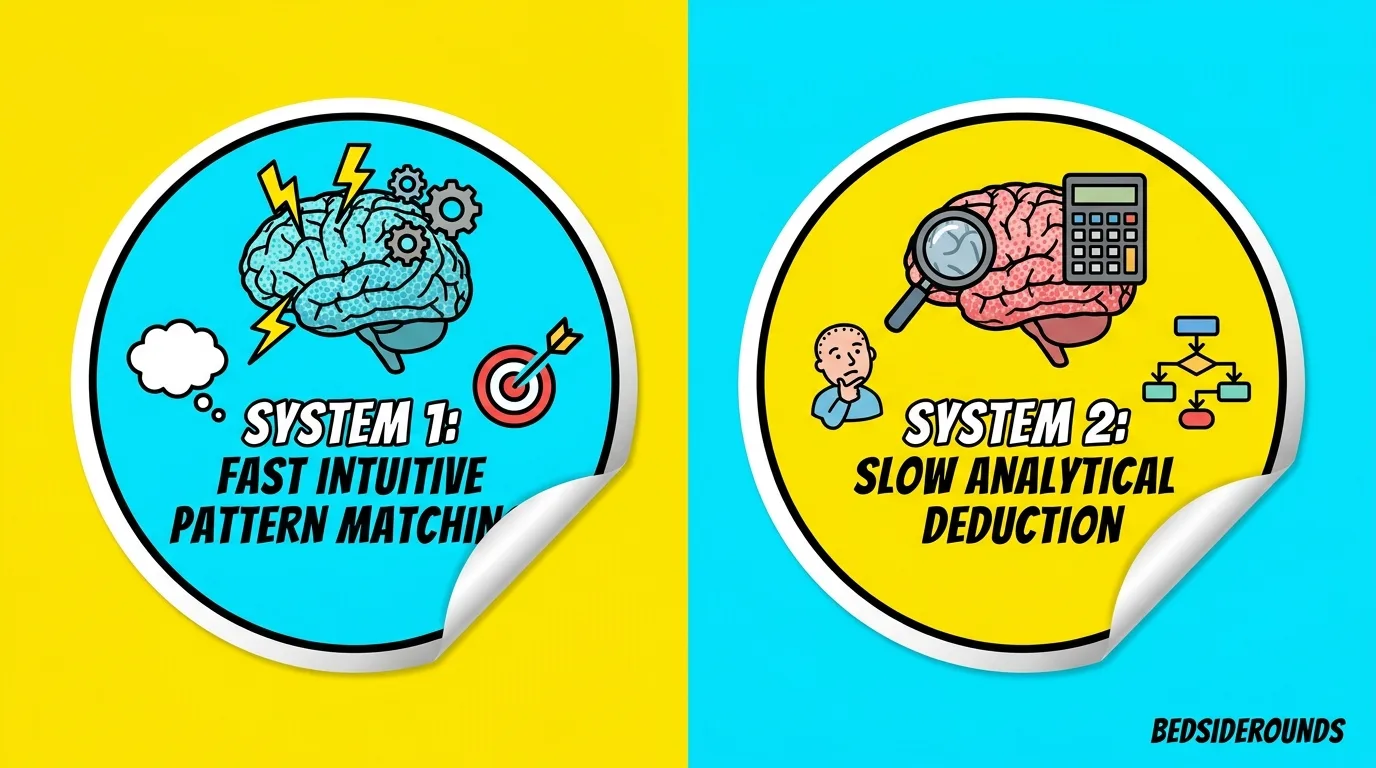
2. System 1 vs System 2 Cognitive Thinking
The human brain utilizes two distinct cognitive modes for clinical decision-making:
| Cognitive Mode | System 1 (Intuitive) | System 2 (Analytical) |
|---|---|---|
| Processing Speed | Fast, automatic, subconscious | Slow, deliberate, conscious |
| Cognitive Effort | Low energy expenditure | High mental load & concentration |
| Primary Mechanism | Heuristics & Pattern Recognition (Illness Scripts) | Hypothetico-Deductive Reasoning |
| Clinical Context | Experienced attending making spot diagnosis | Student / Resident analyzing complex rare case |
| Vulnerability | Susceptible to cognitive biases | Susceptible to fatigue & cognitive overload |
---
3. Illness Scripts & Pattern Recognition
An Illness Script is a structured mental representation of a disease stored in memory:
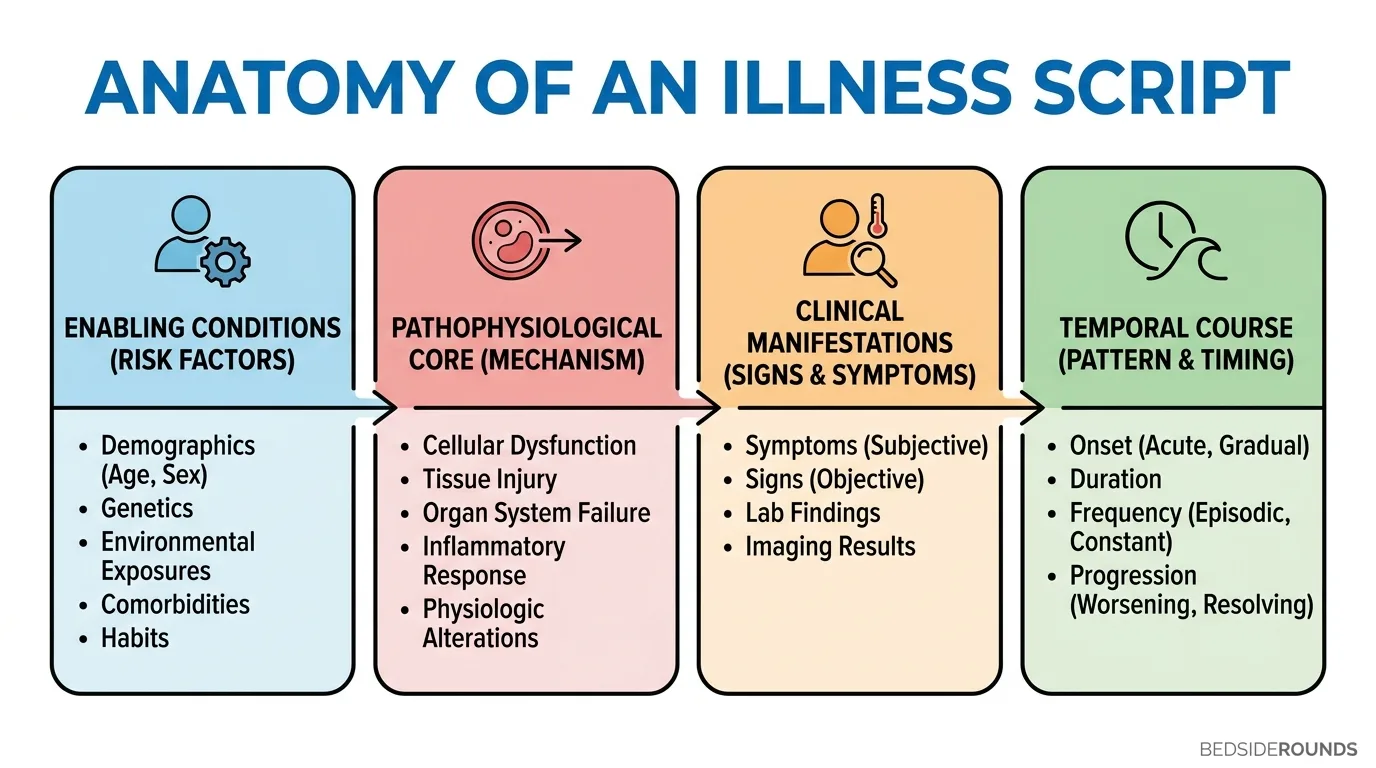
- 1. Enabling Conditions: Age, gender, genetic risk, occupational exposure, travel history.
- 2. Core Pathophysiologic Fault: Plaque rupture, bacterial invasion, autoimmune destruction.
- 3. Clinical Consequences: Symptoms, physical exam signs, laboratory & imaging markers.
---
4. Top 10 Cognitive Biases in Diagnostic Errors Table
Cognitive biases contribute to >70% of diagnostic errors in clinical practice:
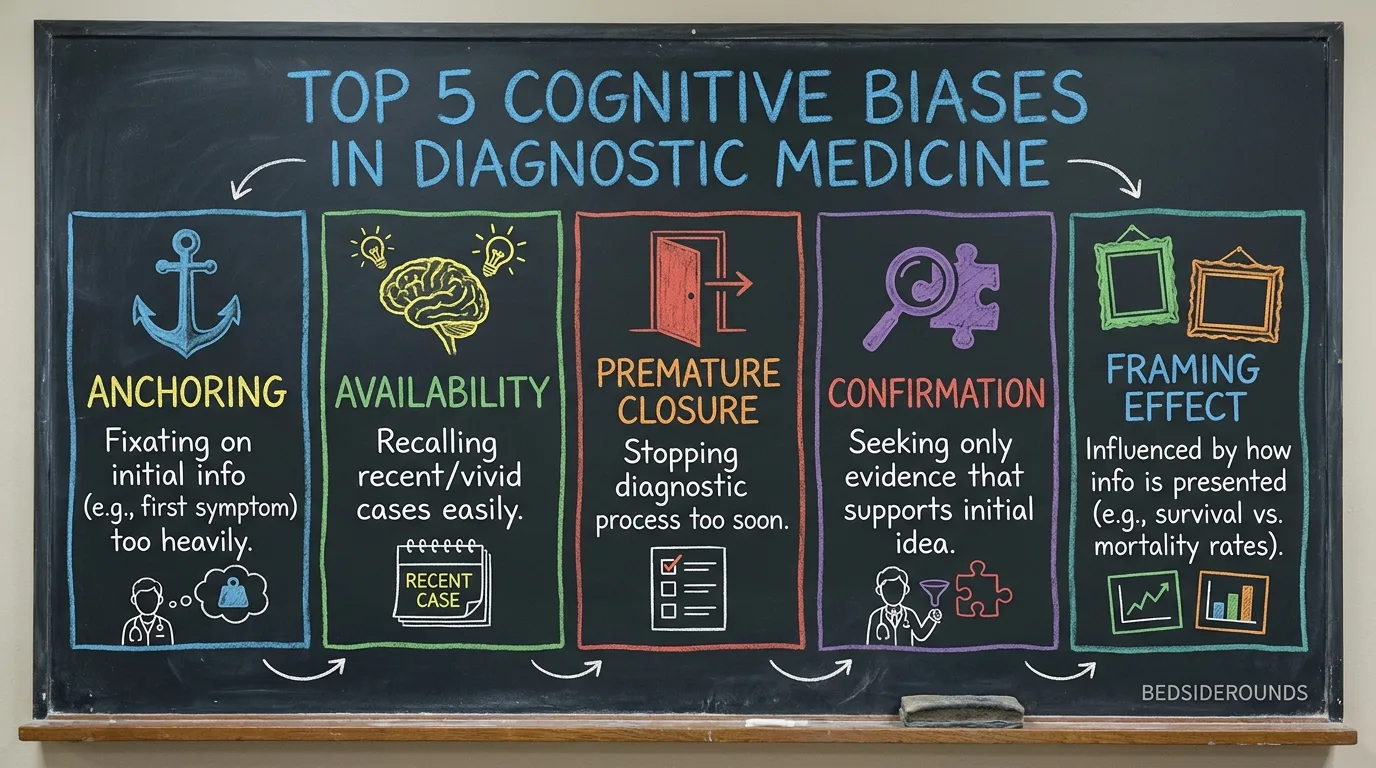
| Cognitive Bias | Definition | Typical Clinical Example | Mitigation Strategy |
|---|---|---|---|
| Anchoring Bias | Fixating on initial features early in diagnostic process | Sticking with "gastroenteritis" despite rising lactate | Re-evaluate differential at every handoff |
| Availability Bias | Judging likelihood based on recent memorable cases | Diagnosing PE in every dyspneic patient after seeing 1 PE | Rely on objective risk scores (PERC/Wells) |
| Premature Closure | Accepting a diagnosis before it has been fully verified | Stopping diagnostic search once 1 abnormality is found | Always ask: "What else could fit these labs?" |
| Confirmation Bias | Seeking evidence to confirm hypothesis while ignoring counter-evidence | Focusing on normal CXR while ignoring high D-dimer | Actively search for disconfirming evidence |
---
5. Diagnostic Debiasing & Metacognitive Checklist
Incorporate metacognition (thinking about one's own thinking) at the bedside:
- 1.Pause & Reflect: Force a System 2 diagnostic pause during complex handoffs.
- 2.Rule Out Can't-Miss Diagnoses: Explicitly document why the top 3 lethal conditions are excluded.
- 3.Check Diagnostic Red Flags: Does any lab or vital sign fail to fit the working diagnosis?
---
6. Advanced Probabilistic Reasoning Equations
▶ Bayes' Theorem for Post-Test Probability
Formula: Post-Test Odds = Pre-Test Odds × Likelihood Ratio (LR)
- Positive Likelihood Ratio (LR+) > 10: Dramatically increases post-test disease probability (Rules IN).
- Negative Likelihood Ratio (LR-) < 0.1: Dramatically decreases post-test disease probability (Rules OUT).
---
7. Flagship Worked Clinical Case Study
Worked Case: Cognitive Anchoring Lead to Delayed Diagnosis
Case StudyA 45-year-old male with a history of alcohol use disorder is admitted for "Alcohol Withdrawal Tremors". 24 hours later, he develops fever (38.5°C), confusion, and tachycardia (120 bpm).
#### 📊 Patient Lab & Diagnostic Panel
| Diagnostic Parameter | Measured Value | Reference Range | Diagnostic Interpretation |
|---|---|---|---|
| Working Diagnosis | Alcohol Withdrawal | Normal | Anchoring Bias Trap! |
| WBC Count | 18,500 /mcL | 4,500–11,000 | Severe Leukocytosis |
| Lumbar Puncture | 1,200 PMNs / High Prot | Normal | Acute Bacterial Meningitis |
| Serum Lactate | 3.8 mmol/L | < 2.0 mmol/L | Severe Systemic Infection |
| Head CT | Meningeal Enhancement | Normal | Acute CNS Infection |
#### ⚡ Step-by-Step Clinical Decision Flowchart
Step 1: Bias Recognition → Team anchored on "Alcohol Withdrawal" label from ED handoff, ignoring fever
Step 2: System 2 Pause   → Attending forces diagnostic timeout: "Why is a withdrawal patient febrile?"
Step 3: Workup Revision  → Stat Blood Cultures + Lumbar Puncture + Non-Contrast Head CT ordered
Step 4: Definitive Diagnosis → CSF shows 1,200 PMNs (Confirmed Pneumococcal Meningitis!)
Step 5: Action & Cure    → Stat IV Ceftriaxone 2g + Vancomycin 2g + Dexamethasone 10mg IV administered
---
8. High-Yield Clinical Pearls for Attending Rounds
Clinically Related Case Posters
Progressive Breathlessness and Leg Swelling
Atrial Fibrillation. Chronic Obstructive Pulmonary Disease (COPD). Sleep Ap...
Sudden Weakness on One Side of the Body
Atrial Fibrillation. Hypertension. Newly detected Dyslipidemia
Altered Mental Status with High-Grade Fever
Benign Prostatic Hyperplasia (BPH). Type 2 Diabetes. Newly detected Anemia
Test Your Decision-Making in Cognitive Bias Identification in Diagnostic Error
Experience this exact clinical scenario in the Bedside Rounds interactive simulator. Order investigations, manage door-to-needle timing, and witness real-time physiological feedback.